
Can Letter Formation Promote Literacy?
Written by Sandie Barrie Blackley, Speech-Language Pathologist
Published on January 21st, 2026

January 23 is National Handwriting Day, established in 1977 by the Writing Instrument Manufacturers Association to encourage people to buy pens and pencils. Today, it seems, our writing involves more key-clicks than ink and graphite, but, as research is discovering, letter formation by hand is a critical step in letter and word identification as well as spelling proficiency, especially among struggling readers and writers.
It’s so critical, in fact, that Lexercise has just released a new online practice game: Letter Formation.
Though we don’t fully understand why, children with dyslexia tend to have less efficient motor control over letter-writing. They may take more time to write letters even as the resulting letters are less legible.
Letter Formation and Literacy
Handwriting is deeply entwined in the brain’s literacy network. Children who have difficulty with handwriting often have problems with spelling and language fluency. In addition, children with dyslexia may struggle with mirror invariance for letter images. Mirror invariance is a normal and helpful feature of the mammalian brain. It refers to the ability to recognize a mirror image as the same object.
A chair is recognized as a chair no matter which way it is turned. A person’s face can be recognized from multiple vantage points. But, to master literacy, a student must overcome mirror invariance for alphanumeric symbols. Letters are special. A -b- is not the same as a -d- and a -p- is not a -q-.
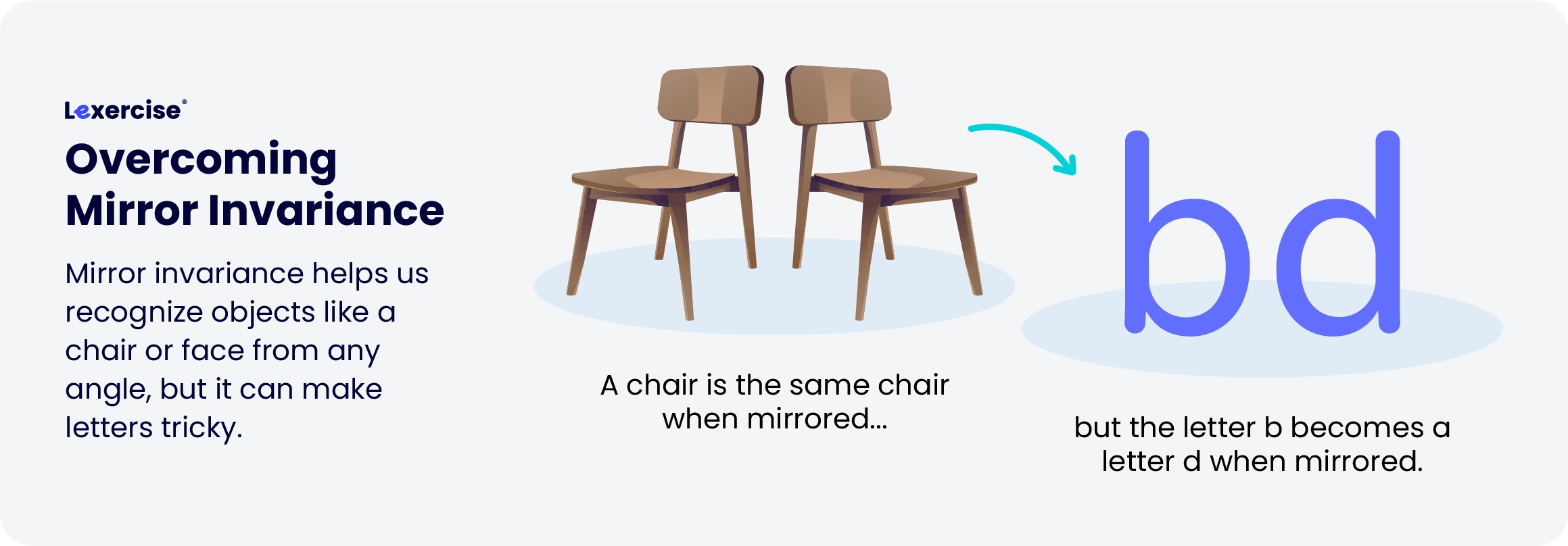
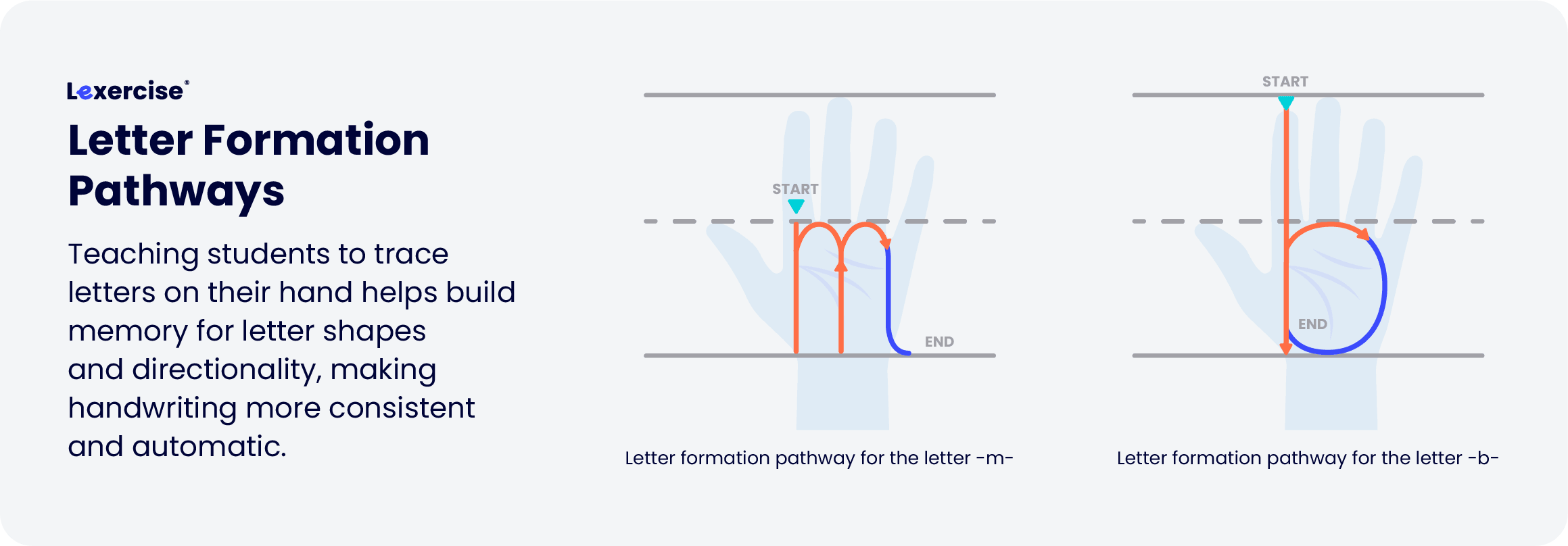
Neuroscience has shown that overcoming mirror invariance for letters is facilitated by attending to the hand’s movement pathway when forming letters. Each lowercase letter has a distinctive movement pathway – where it begins, how it moves and where it ends (entry, movement, exit).
To achieve fluency, this pathway is followed every time the letter is written and practiced over and over until it can be done with unconscious ease. Students who are taught to form letters using a targeted, structured, movement-based handwriting approach recognize letters more quickly, decode and spell words more accurately and fluently, and formulate written language more easily.
Unfortunately, in the U.S., a structured approach to handwriting is not supported in public education and the Common Core State Standards curriculum has no specific guidance about how to teach this vital skill. While research supports teaching transcription (letter and word writing using a writing tool), teachers are rarely trained for the task.
Letter Formation Practice Helps Students Overcome Difficulties
The good news is that a targeted structured approach to letter formation can help students to overcome difficulties related to mirror invariance and letter identity and become more fluent writers, spellers, and readers.
The Lexercise Letter Formation game teaches students each letter’s distinctive movement pathway. The goal is legible, fluent, and automatic handwriting that promotes comprehension and memory and does not disrupt written expression. The multisensory (kinetic) focus can help dyslexic children anchor in memory otherwise confusable letters. For example, -d- and -b- have opposite movement pathways, so when learned as movement pathways they are not at all confusable!

We invite you to try Letter Formation and the other Lexercise practice games and of course we are happy to answer your questions about online reading, writing, and spelling therapy for dyslexia and other language processing differences.
Improve Your Child’s Reading
Learn more about Lexercise today.
Schedule a FREE
15-minute consultation