
Flipping Virtual Structured Literacy Intervention
Written by Sandie Barrie Blackley, Speech-Language Pathologist
Published on March 31st, 2020
 Teachers have been using
Lexercise for Schools to provide online lessons for their struggling readers during the coronavirus pandemic. Many of these teachers have been offering us valuable feedback and telling us what they need in order to reach more students. These conversations have led to some exciting changes in the teacher dashboard and the flexibility with which teachers can use the Lexercise for Schools platform. In the pre-pandemic days, teachers started with a 45-minute lesson. Online student practice followed each lesson. But teachers told us that some students couldn’t be there for the lesson; some had school scheduling difficulties or – especially since the pandemic has closed schools – due to internet connectivity issues. Practice, on the other hand, has been less of a barrier because it can be done at any time or, in a pinch, using a cell phone, connecting with cellular towers rather than cable or fiber internet.With this valuable feedback in mind, we have re-designed the Lexercise for Schools teacher dashboard. Instead of a lesson-first protocol, the changes make it easy for a teacher to begin with a few days of student practice using Lexercise games. The Lexercise interface reports each student’s accuracy so, after a few days, the teacher can see who is mastering the decoding and spelling patterns and who isn’t. The teacher can get a detailed report on every student’s practice to see exactly which words and which concepts are causing difficulty. Then the teacher can schedule an individual or group lesson and/or short concept-focused instruction to explain and provide guided practice with the concept(s).
Teachers have been using
Lexercise for Schools to provide online lessons for their struggling readers during the coronavirus pandemic. Many of these teachers have been offering us valuable feedback and telling us what they need in order to reach more students. These conversations have led to some exciting changes in the teacher dashboard and the flexibility with which teachers can use the Lexercise for Schools platform. In the pre-pandemic days, teachers started with a 45-minute lesson. Online student practice followed each lesson. But teachers told us that some students couldn’t be there for the lesson; some had school scheduling difficulties or – especially since the pandemic has closed schools – due to internet connectivity issues. Practice, on the other hand, has been less of a barrier because it can be done at any time or, in a pinch, using a cell phone, connecting with cellular towers rather than cable or fiber internet.With this valuable feedback in mind, we have re-designed the Lexercise for Schools teacher dashboard. Instead of a lesson-first protocol, the changes make it easy for a teacher to begin with a few days of student practice using Lexercise games. The Lexercise interface reports each student’s accuracy so, after a few days, the teacher can see who is mastering the decoding and spelling patterns and who isn’t. The teacher can get a detailed report on every student’s practice to see exactly which words and which concepts are causing difficulty. Then the teacher can schedule an individual or group lesson and/or short concept-focused instruction to explain and provide guided practice with the concept(s). 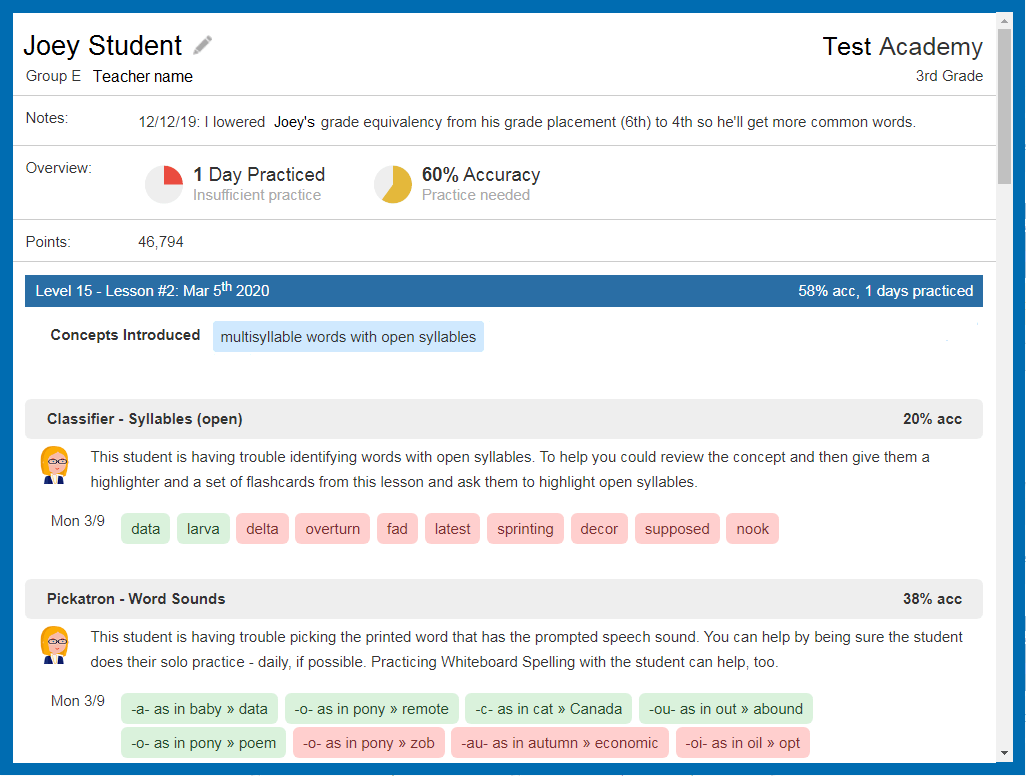
Improve Your Child’s Reading
Learn more about Lexercise today.
Schedule a FREE
15-minute consultation