
The Simple View of Reading
Written by Sandie Barrie Blackley, Speech-Language Pathologist
Published on March 31st, 2016
 It seems as though there is a plethora of reading problems one could be affected by, but through extensive research, Wesley Hoover who wrote the academic paper The Simple View of Reading has categorized them into two main groups: Listening Comprehension and Decoding & Spelling.
Listening comprehension includes skills such as vocabulary, following spoken directions, and understanding the nuances of a story that is read out loud. Decoding and spelling problems deal with word and sub-word processing.
The formula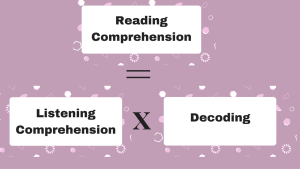
The Simple View of Reading has a formula that suggests reading comprehension is equal to listening comprehension multiplied by decoding (word recognition).
In recent years, the formula has been tweaked slightly to increase its accuracy by including fluency, word reading speed and spelling– which is another measure of word and sub-word processing.
The application
The Simple View is related to two categories of reading disorders:
- Listening Comprehension Deficits = Specific Language Impairment (SLI)
- Word Reading Deficits = Dyslexia
This is important to consider because specific language impairment and dyslexia require dramatically different interventions.
- Specific Language Impairment (SLI) requires an intervention that strengthens listening comprehension.
- Dyslexia requires a structured literacy intervention such as the Orton-Gillingham method.
We value your time and resources, so we focus on the side of the formula where intervention can make the biggest difference. This will differ from person to person, so Lexercise personalizes instruction to each student.
Improve Your Child’s Reading
Learn more about Lexercise today.
Schedule a FREE
15-minute consultation