
The History of Orton-Gillingham
Written by Sandie Barrie Blackley, Speech-Language Pathologist
Published on June 27th, 2016
 Their areas of expertise fit like puzzle pieces from the same box, aligned perfectly to create a teaching method that would stand the test of time. Samuel T. Orton and Anna Gillingham married their ideas to create a teaching manual for children with reading disabilities.
Samuel T. Orton started as a pathologist who worked with adult brain damage patients, which led him to wonder why some children without any brain damage still had language disabilities. In 1925, he set up a two week mobile clinic to evaluate low-performing students referred by teachers. Orton found that fourteen of the students referred only had difficulties in reading and had near average, average or above average IQ scores. He found this peculiar and eventually chalked it up to the left and right brains not working together properly.
He created the concept of “multi-sensory” teaching to attempt to combat this issue. He integrated kinesthetic learning strategies with the teaching of visual and auditory concepts. Later, he began working with educator and psychologist Anna Gillingham, to create what is now referred to as the Orton-Gillingham method.
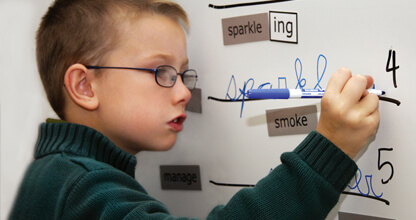
Gillingham trained teachers and published instructional materials regarding reading instruction. She devoted her life to the maxim that in teaching, “One should establish associations involving the simplest possible units and should use various reinforcement techniques to create solid association links.”
She introduced a systematic and orderly approach of categorizing and teaching sets of 70 phonograms, single letters and letter pairs representing the 44 discrete sounds found in English to Orton’s findings and the method was born. His science and her teaching ability made the perfect pair.
The Orton- Gillingham method started as a sequential, alphabetic-phonetic multi-sensory program as a tool with which students could easily create meaningful syllables. The approach eliminated the need for a child to memorize almost all words in a language, limiting to those that were non-phonetic.
At Lexercise, the Orton-Gillingham method is our teaching tool of choice because it is backed by years of research. Two brilliant people came together to create a manual for young people who struggle with reading. Though the Orton-Gillingham method was created in the 1930s, it continues to be researched and backed by credible sources. You can read more in our most recent article, How Does Orton-Gillingham Treat Dyslexia.
Make sure you subscribe to our Blog below for the latest research information, tips for parents and students, and more!
Improve Your Child’s Reading
Learn more about Lexercise today.
Schedule a FREE
15-minute consultation